mink
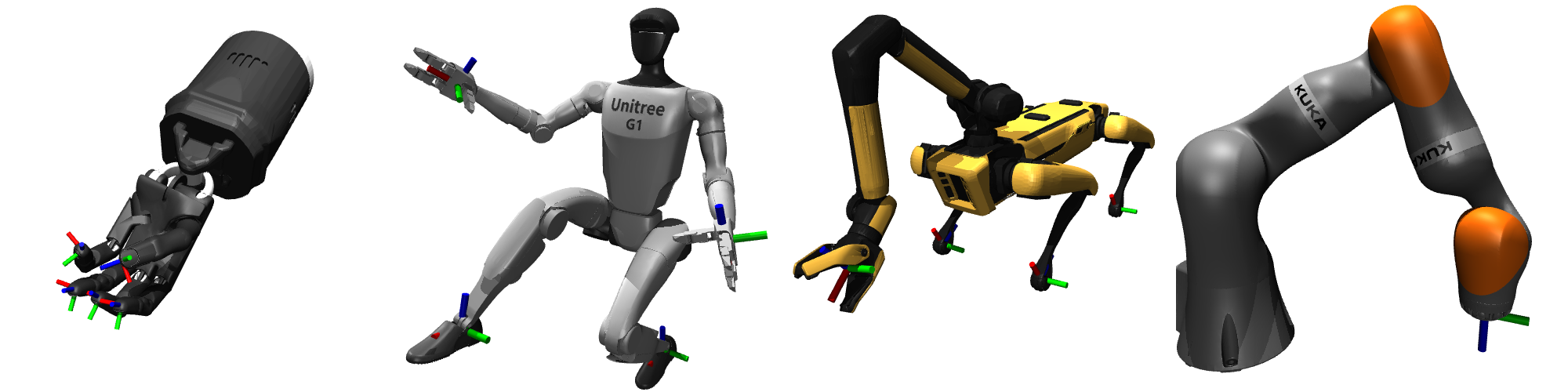
mink (MuJoCo inverse kinematics) is a library for differential inverse kinematics built on top of the MuJoCo physics engine.
It solves the following problem: given a robot’s current configuration and a set of task-space objectives, compute a joint velocity that best satisfies those objectives while respecting constraints.
Tasks specify what the robot should do—place a foot on a ledge or reach a handhold— while limits specify what it must not do—exceed joint limits or collide with obstacles. At each control step, mink formulates this as a quadratic program and solves for a locally optimal joint velocity.
Differential inverse kinematics is widely used in motion planning, legged control, teleoperation, and motion retargeting.
Why mink?
Composable task abstraction Specify multiple task-space objectives—such as placing a foot and regulating the robot’s center of mass—and combine them in a single solve step.
Graceful handling of constraints Objectives and constraints are combined in a single optimization problem, enabling principled trade-offs when commands conflict or cannot be fully satisfied.
Designed for real-time control A fast, local solver intended to run every control step, making it suitable for real-time control applications.
Minimal example
Drive an end-effector to a target position:
import mujoco
from mink import Configuration, FrameTask, solve_ik
model = mujoco.MjModel.from_xml_path("robot.xml")
configuration = Configuration(model)
task = FrameTask(
frame_name="end_effector",
frame_type="site",
position_cost=1.0,
orientation_cost=0.0,
)
task.set_target_from_position([0.5, 0.0, 0.3])
for _ in range(max_iters):
vel = solve_ik(configuration, [task], dt=0.01)
configuration.integrate_inplace(vel, dt=0.01)